
Novo Hair
- EOT Sale Details
- 100% sale on 8 April 2026
- Office Address
- 18-20 Main Rd, Hockley SS5 4QS
- Website
- https://novohair.co.uk/

A close-knit team
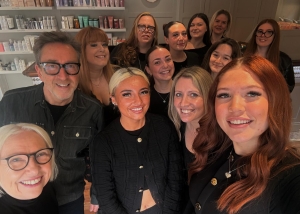
Kevin has owned hairdressing businesses since 1983 and established Novo Hair in 2004. Today, its Hockley salon has a team of 16.
The business has performed steadily over the years, and Kevin attributes much of its success to the loyalty and experience of its people. His longest-serving stylist has worked with him for more than 30 years, two other team members have passed the 20-year mark, and another has been with the business for 16 years after originally joining for a Saturday job.
“I go by that old Richard Branson saying: ‘Train people well enough so they can leave; treat them well enough so they don’t want to,’” Kevin says.
The EOT seed takes root
Kevin first heard about EOTs back in 2019. “I absolutely loved the concept,” he enthuses. But what frustrated him was the price tag. The EOT transaction seemed to be priced for companies many times Novo Hair's size. With an 8-10% margin and turnover below £1 million, professional fees of £40,000–£50,000 were never going to add up for his business.
“It wasn’t viable," he says. “The prices I was being quoted for the transaction would discourage founders of small businesses from taking the employee ownership route.”
Kevin remained convinced by the idea, but he needed to find a way to make it work financially. For several years, that option did not appear to exist.
Why not just sell the business?
A conventional sale did not provide the answer either. Three proposed trade sales fell through over the years, each for a different reason.
In one case, an offer of a lump sum became a proposal for deferred payments, leaving Kevin with £12,000 in legal costs when the deal collapsed. Another buyer wanted him to remain tied to the business for five years on terms that did not work for him. In the third proposed sale, the price was reduced by 40% shortly before completion.
Each failed deal made Kevin more certain that an EOT was the exit he wanted.
Preparing the business for life after the EOT sale
Kevin had been working with business adviser Kingsley Tedded of Mobius Groupsince 2019, checking in around twice a year. Together, they considered how an EOT could work and what Novo Hair needed to put in place so the business could operate successfully as Kevin gradually stepped back.
“To be a successful EOT, your business has to be able to run without its founder, or it isn't ready,” comments Kevin.
Kevin read and listened to everything he could find about EOTs. Then, in 2025, a podcast led him to Go EO.
Working alongside Kingsley, Go EO could provide the cost-effective transaction support Kevin had spent years looking for. Kingsley focused on preparing Kevin and the business for the transition, while Go EO handled the valuation, tax and legal elements of the EOT sale.
Why did Employee Ownership seem right for your business?
“For us it seemed a perfect solution – we could withdraw gradually, our team would benefit as we really care about them and it was beneficial for us all. We would get a reward for the hard work we both put into building the company yet it wouldn’t be at the expense of everyone else.
We felt our small team would be even more motivated to achieve growth and success if they shared in that success. Nothing will give us more joy than to see the company thrive when we’ve stepped back entirely.”
Completing the EOT transaction
Kevin found the process, and Go EO’s online portal, refreshingly easy to use.
“It's like buying a house should be,” he says. “There are the defined steps in the process, and with Go EO’s portal you know exactly where you are and what you need to do at every stage.”
“It was the least stressful big thing I've ever done in my life.”
What would Kevin do differently?/h2>
On the day the EOT transaction completed, Kevin was excited to make a big announcement to his team. He assumed the news would trigger an instant celebration. Champagne was on ice, cakes were ready, a framed photo of the whole team as the ‘new owners’ sat in the wings.
But instead, the announcement prompted lots of questions. “If I can get a share of the profit from the business, does that mean I am liable if it goes bust?” was one of the initial concerns.
With hindsight, Kevin accepts that he expected everyone to understand a complicated idea far too quickly. “It took me, a pretty financially savvy businessman, a while to get my head around the full concept of an EOT. Yet I was expecting all my staff to grasp it in three minutes.”
His practical advice to other founders is to begin communicating about the EOT sooner. “Telling my team earlier would be the big thing I would do differently.”
How the EOT began to sink in
The team’s understanding of the EOT developed much more gradually. People went home, discussed the EOT with friends and family who were equally unfamiliar with the concept, and returned with more questions. It took repeated conversations and ordinary moments within the salon for the idea to begin feeling real.
One of those moments happened beside Novo Hair’s commercial tumble dryer. Kevin noticed two members of the team cleaning its filter, a small maintenance job that could prevent a £120 call-out. One remarked that Kevin must be pleased he wouldn’t be paying the bill for a breakdown.
Kevin explained that it wasn’t just “his money” at stake. The business was now held for the benefit of the team, so looking after its equipment helped protect something in which they all had an interest.
Kevin describes exchanges like this as “little chips”: small realisations that gradually help people understand what having a stake in an employee-owned business means.
What’s next?
Kevin’s not going far. Over the next five years, as the sale pays out, he plans to stay involved, he plans to stay involved, gradually reducing his hours. Beyond Novo Hair, he has a longer-term ambition to support other small business owners, particularly other salon owners considering employee ownership for themselves.
“When something seems too good to be true, it often is,” he says. “But that’s not the case with EOTs. I think it’s a great business model that can genuinely work for both the founder and the team.”