
Your decision matters
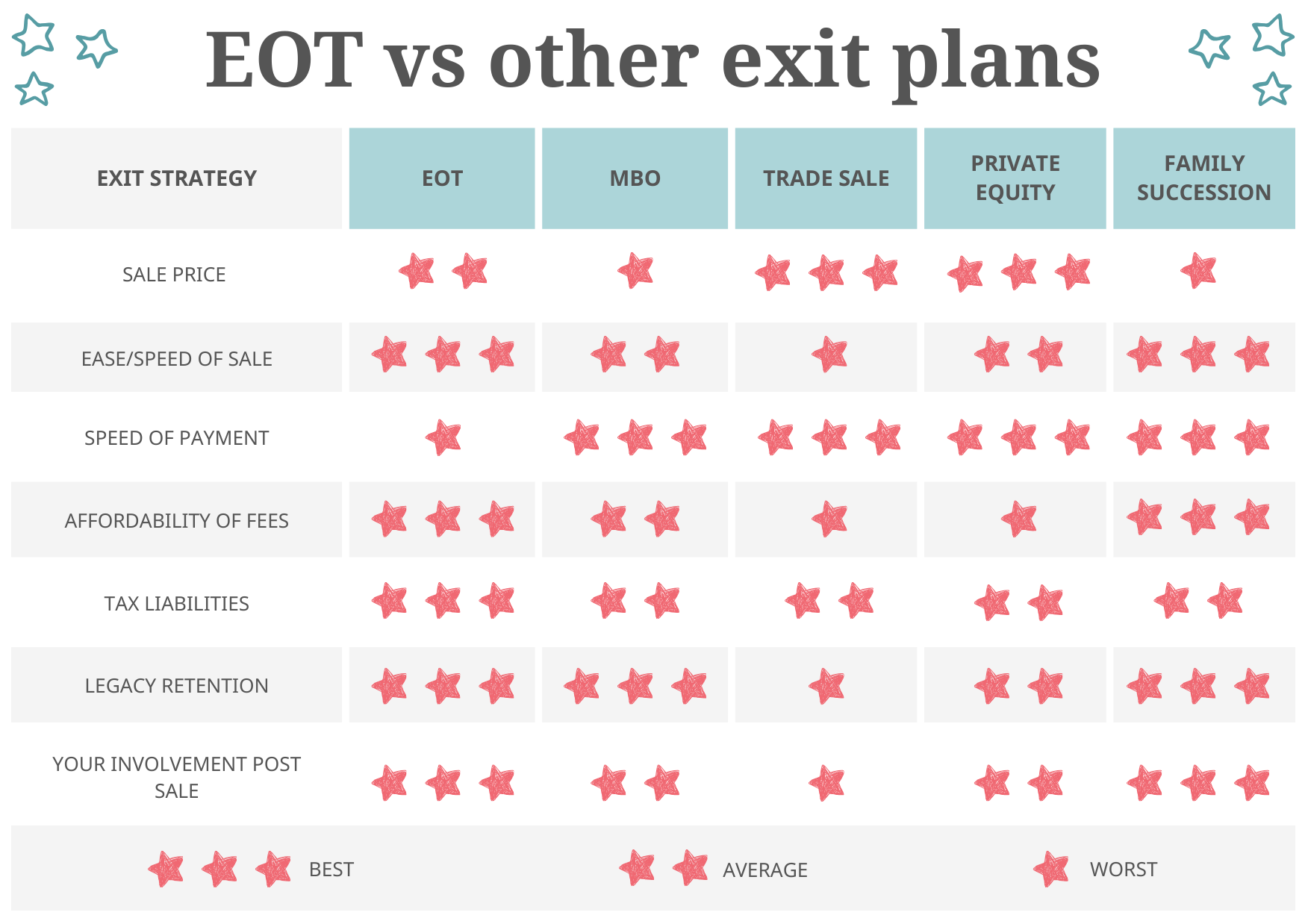
When you’ve spent decades building up your business, deciding how to exit is a big deal. Your decision isn’t a simple financial choice. It will affect your future and impact your team, your culture, and your business. Questions you’ll ask will be around speed of sale, sale price, tax liabilities, and how much involvement you really want post sale.
Compare the options
Trade sale
You've built something valuable, and there's a buyer out there willing to pay a tidy sum for it - what's not to like? The cash injection could be very substantial and also relatively quick. All of which gives you the opportunity for a clean break. But if you are considering the bigger picture, there are other consequences of a trade sale.
The brand you’ve carefully nurtured? It will probably be lost in the new company’s identity. Your team of loyal employees who helped build the business? They could find themselves out of a job due to restructuring or “synergies”.
Trade sale vs EOT
Compared to an EOT sale, the negotiation and completion of a trade sale can be a lengthy process. This can have the knock on effect of making a trade sale a costly process compared to selling to an EOT. There are usually significant legal and financial fees involved as both the vendor and the buyer negotiate for the best deal. But once negotiations are complete, the payment is generally much quicker than an EOT.
With an EOT, you're selling to the people who already understand and value your business and culture. The transition tends to be smoother with minimal disruption to the day-to-day. The payment period is generally longer as there’s no external cash coming in, but you'll likely benefit from the Capital Gains Tax relief on the sale proceeds. Psychologically, there's something deeply satisfying about knowing the team will reap future rewards from the business they helped you build.
Private equity
Private equity firms come bearing gifts – impressive valuations, promises of growth, and capital to fuel expansion. There's no denying they can put serious money on the table. But remember, they're not in it for the long term; they're in it for the returns. Their investment timeline is typically three to seven years, after this they’ll want to sell your business on for a profit.
While a private equity deal might look attractive, it often comes with strings attached. You may be required to stay involved, but this time working under someone else's targets and timelines. Your business could be pushed in a direction that prioritise rapid growth over the values you've carefully crafted. And your team? They might find themselves working in a more pressured environment with changing expectations.
EOT vs private equity
An EOT, by contrast, is a very different type of transition. You won't get the same immediate payday that comes with private equity. But you'll probably sleep a little better knowing your business isn't being prepped for another sale in a few years. Plus, your team gets to continue the business in line with its core values, rather than trying to meet aggressive growth targets set by outside investors.
Management buyout
Management Buyouts (MBOs) have historically been a popular option for founders who want to exit the business while also keeping their company culture intact. The idea is that your senior team buys you out, and everything continues largely as before. But economic times have changed. The next generation often struggles to scrape together enough for a house deposit, let alone find extra cash to buy your business shares. This could mean you end up taking a lower price for the business.
EOT vs management buyout
An EOT solves this funding problem. Unlike an MBO, your employees don't need to personally raise capital - the trust buys the business and holds it on behalf of all employees, not just those who can afford to buy in. While MBOs create a limited pool of new owners, EOTs spread ownership across your entire workforce, creating a more inclusive legacy. Both options typically involve a longer payment period compared to a trade sale, but EOTs also offer a tax advantage.
Family succession
What better way to preserve your legacy than keeping it in the family? In theory, your business stays with those who share your name and (hopefully) your values. Great in principle. But are your family members actually interested in taking over? Do they have the right skills? And what about those awkward conversations when opinions differ on business decisions?
EOT vs family succession
If preserving your legacy and looking after your employees is a key priority for you, an EOT allows you to step back gradually, maintaining some involvement while transferring ownership to the entire team. You’ll walk away eventually, with a fair market value for your shares as well as tax benefits that family transfers don't typically enjoy. But if any of your family continue to work in the company, an EOT means they’d have no more power than any other employee.