
On this page
- The realities of early profit share amounts
- Who qualifies to receive EOT profit share?
- What are the rules for an EOT profit share bonus?
- How can an EOT profit share be divided?
- Pros and cons of EOT profit share splits
- Other considerations for the EOT profit share
- Can we change the way we split the profit share?
- Can an EOT still pay performance bonuses?
- Who decides the profit share in an EOT?
- How is the profit share paid?
- How does EOT profit share affect Corporation Tax?
- How often should you pay the EOT profit share?
- When's the best time to pay the EOT profit share?
- Where does profit share sit in the order of payments?
- Are there any situations where staff can be excluded?
- What about freelancers and subcontractors?
- The bottom line
- Want to learn more about EOTs?
- Read more
Profit share is one of the most well-known elements of an EOT. It's the mechanism that turns "the business belongs to everyone" from an abstract idea into something tangible for the staff.
Every year, the first £3,600 of any employee’s profit share bonus is free from income tax. But the way it’s divided must follow specific rules.
Find out how profit share works in an Employee Ownership Trust (EOT), including how the £3,600 tax break works, who is eligible, how the profit share can be divided, and the practical considerations for directors, trustees and payroll.
The realities of early profit share amounts
Profit share may be modest (if any) during the early years of the EOT. The business is paying back the founder the deferred consideration, which often uses much of the company’s available profits and cash. It's important to manage staff expectations around the profit share when you announce and talk about the EOT to the team.
Who qualifies to receive EOT profit share?
Your trust deed typically lays out the minimum length of service with the business before employees become beneficiaries of the trust, and therefore qualify for a share of profits. The time period can be any length, from nil (meaning you qualify on your first day) up to 12 months.
If a business has an amazing new starter who doesn’t qualify for the profit share, management does have the option to give these team members a discretionary bonus. But this would not be EOT profit share and would be fully taxable.
What are the rules for an EOT profit share bonus?
For a profit share bonus to be eligible for EOT tax relief, payments must be split equitably. This means you can’t single out individuals, teams or departments positively or negatively, i.e. it can’t be performance-based. All eligible staff must receive a share on the same terms. This does not mean everyone has to get the same amount (though you can choose to do this).
How does a profit share qualify as “equitable”?
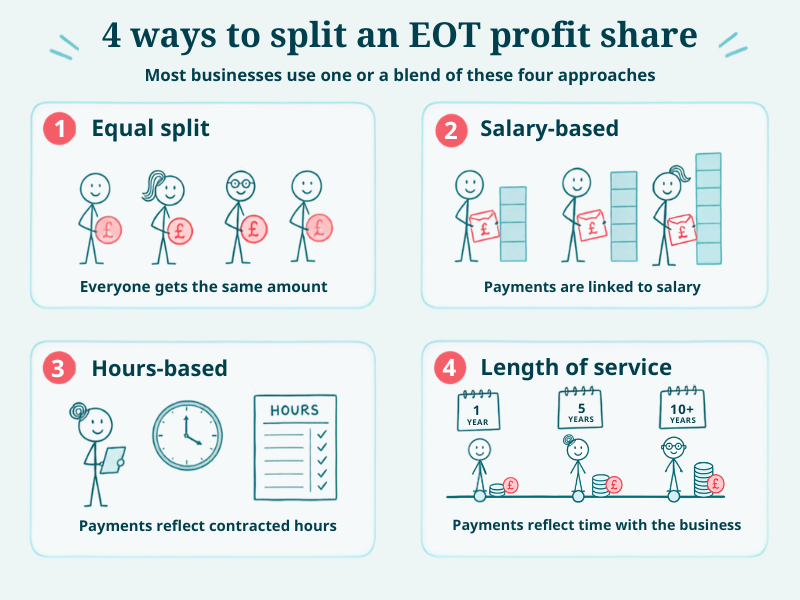
Thankfully HMRC do elaborate on what qualifies as “equitable”. You can choose to split profit share payments equally, in line with salary, length of service, or hours worked.
Exiting founders are eligible for profit share payments if they’re still on the payroll. For awards made on or after 30 October 2024, directors can choose to be excluded from the distribution altogether if they wish, without this affecting the scheme's participation requirement. Meaning you can give the entire pot to your staff. Directors are under no obligation to do this, but some highly paid directors (especially those receiving performance-related bonuses) might feel they should opt out of the EOT profit share.
The way you split your profit will depend on how your business is run, as well as your culture and values. The word bandied around in profit share discussions is “fair”. But everyone has a different idea of what's fair. Take a business with a few senior staff driving most of the profit, and junior staff with little influence over it. Is it “fair” to equally share the profits among the team?
The pros and cons of EOT profit share splits
Equal profit share
Every staff member gets paid exactly the same share of profit. Perhaps the “fairest” distribution on paper, but it doesn’t distinguish between a junior part-timer who's only been with the firm a year and an old hand who has worked there for 10 years.
Salary-based profit share
The distribution ties the profit share to what people already earn. It feels familiar and objective, but it also means higher earners get a bigger slice, which may feel at odds with the principle of shared ownership in some company cultures.
Hours-based profit share
The share of the profit is worked out according to the number of hours worked. This can make sense for a business with lots of part-time or variable working. If you’re considering this split, be aware that HMRC's rules require every eligible employee to receive something, meaning you need to be careful with zero-hours contracts and team members on maternity or sick leave. One option may be to base the calculation on contracted rather than actual hours.
Length of service profit share
This rewards loyalty. While it might seem like a great idea to reward experienced staff, how does it make new starters feel about how their contribution is valued? It can work against you at a time when you’re trying to engage team members.
A blend of the above
You can mix and match. For example, some businesses might choose to allocate up to £3,600 each across all staff, with the excess allocated in line with length of service. This would enable as many employees as possible to benefit fully from the tax-free element, while skewing larger profits towards those who have worked for the company the longest.
In theory a business could allocate 25% of the profit share pot to each of the above methods, or some other split... but a word of caution...
Other considerations for the EOT profit share
A formula that appears simple at first glance can get complicated. For example, you decide to split it based on salary. Do you take people’s salaries before or after pension sacrifice? What about staff on maternity leave or sick pay? How do you deal with overtime? Each answer adds another layer to what started as a simple idea.
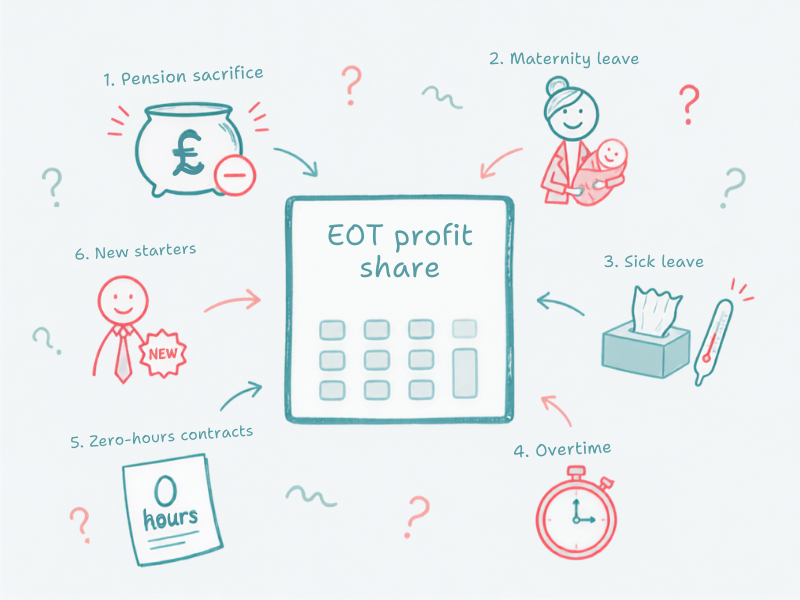
We’re not trying to put you off using salary as the metric; other choices can have complications too. Our point is that some businesses may think it's best to try to adopt a few (or even all) of the options, so everyone gets something, long-term staff get a boost, as do high earners and those who work the most hours. But if you opt for this, the calculation can quickly get unwieldy!

Thinking about an EOT? We'll help you work out the right next step.
Book my free video call with Chris
We always respond within 24 hours.
Can we change the way we split the profit share?
Yes, in theory every time an EOT profit share payment is made you could divide it up in a different way (as long as it met the "equitable" criteria detailed above). However, any time you change the methodology, you’ll inevitably have winners and losers. While the winners may well be happy, the losers may grumble, potentially loudly, and with good reason; a decision trustees have just made caused them to get less money than they otherwise would.
So, while the methodology can be changed, our general recommendation is to put a lot of thought into how you’ll split your first profit share, then stick with that method until/unless there’s a good reason to change!
Can an EOT still pay performance bonuses?
Just as in any other business, an EOT can still award pay rises, performance-related bonuses and other discretionary bonuses. These can be paid to specific individuals, based on whatever metric you choose. For example, people in sales can still earn commissions; leaders can still be paid a bonus when targets are met; other team members can receive performance-related payments. But these will not be EOT profit share payments and will not qualify for EOT tax relief.
Who decides the profit share in an EOT?
The trading company directors are in the best position to decide whether money can be added to the profit share pot and, if so, how much. They must be confident that after accounting for company liabilities and deferred consideration payments, there are sufficient retained earnings to justify the profit share payment.
The trustees must approve the total amount and then decide how to apportion it among eligible staff.
How is the profit share paid?
Once you have calculated the amounts per person, these sums should be added to the payroll, separate to normal salary. The payment must be processed using the correct payroll codes to ensure that the first £3,600 per person, per tax year, is income tax free, but that NICs still apply to the bonus. If anyone gets more than £3,600, the excess is taxable and is also subject to NICs. Your payroll software or accountant should be able to accommodate this. These profit share bonuses can be paid with normal salary, so staff just get a bigger net pay. A benefit of processing everything through payroll is that no employee should need to complete a personal tax return, unless they do so for other reasons.
How does EOT profit share affect Corporation Tax?
As these sums go via payroll, they’re valid business expenses for Corporation Tax purposes. This is very different to the deferred consideration payments to exiting shareholders (or dividend payments to ongoing shareholders) which are distributions of post Corporation Tax profits. As a result, 100% EOT owned companies can end up having minimal Corporation Tax liabilities in the longer term if they pay out most of their profits to staff.
How often should you pay the EOT profit share?
There's no set minimum or maximum for how often you pay profit share. Most businesses do it at least once a year, if only to avoid missing out on the £3,600 tax-free allowance. It works on a use-it-or-lose-it basis, so any unused allowance doesn't carry forward. Paying annually also means the sums are more likely to feel meaningful, rather than disappearing into everyday spending. The flip side: staff who are finding things tight might not want to wait months for a payment when the business could afford one sooner.
When's the best time to pay the EOT profit share?
There's no right or wrong answer here. Some businesses tie profit share to Christmas; others to their financial year-end, once the figures are confirmed. If your business is seasonal, it might be worth paying shortly after your busy period. That way, staff have a reason to stay put through the busiest, most important stretch, rather than leaving you short-handed right when you need them most.
Where does profit share sit in the order of payments?
Profit share payments sit near the bottom of the list. Staff salaries and pension contributions come first. Profit share, by contrast, only ever comes out of what's left over once the business has covered its costs. This especially matters in the early days of an EOT becuase the business must first make its deferred consideration payments to the exiting founder, before any profit share is paid out. That's a fixed debt of the trust, so it gets settled before anything is shared with staff.
Are there any situations where staff can be excluded?
As a general rule, if someone's on the payroll, has met the qualifying length of service, and isn't a director who's chosen to opt out, they need to be included. There's only one narrow exception: staff going through serious disciplinary proceedings. Even then, tread carefully and take legal advice to make sure you are not breaching any rules. You can't exclude someone from profit share just because their performance was poor, or because they made a mistake shortly before payment.
What about freelancers and subcontractors?
These types of workers won’t be entitled to receive anything. The clue is in the name; Employee Ownership Trusts are only relevant to employees. Having said that, similarly to very new staff who haven’t been employed long enough, there's no reason why the business can’t offer to pay freelancers a little extra something, if it’s felt warranted. But again, this would not be an EOT profit share, so wouldn’t qualify for the tax perks.
The bottom line
Whatever way you choose to divide your profits, someone will think it's unfair. There’s no perfect formula. Adopt something simple and sensible and stick with it until there's a good reason to change. Pick the method that fits your culture, apply it consistently, and resist the urge to fine-tune it every year.
Want to learn more about EOTs?

Our free 10 EOT Essentials handbook covers the key things every founder should understand before selling to an EOT. From payment plans to profit sharing, business suitability to trustee boards, it deals with the technical, the psychological and the practical.